
Hago Wiki > Sodium Benzoate
Sodium Benzoate
The Acidic Protector & Bacteria Stopper
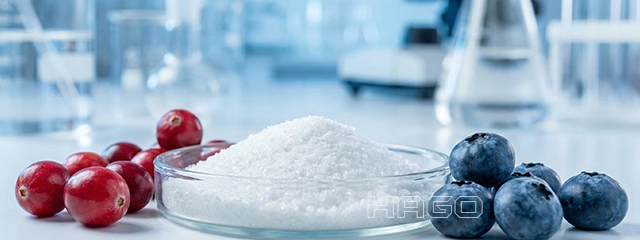
What is Sodium Benzoate? It is the sodium salt of benzoic acid. Although produced synthetically for cosmetic purposes, it has a natural role model: Benzoic acid occurs in many fruits, particularly rich in cranberries, blueberries, and plums, to protect them from spoilage. In cosmetics (and also in food as E211), it is a proven, mild preservative that is particularly valued in natural cosmetics.
🛡 The Acid Specialist
Sodium benzoate has a very specific area of application. It is not a "cure-all," but a specialist that performs at its best under certain conditions.
- The pH Requirement: It only works in an acidic environment. The pH value of the product must be below 5.5 (ideally below 5.0) for the effective benzoic acid to be released.
- Spectrum of Activity: It is particularly strong against bacteria and some yeasts.
- Team Player: Since it is often not sufficient alone against all molds, it is almost always combined with other mild preservatives (such as potassium sorbate) to ensure complete protection.
🌿 Safety & Acceptance
Why is this synthetic substance used so often in certified natural cosmetics?
The Advantages:
- Food Grade: As an approved food additive, it is considered safe and well-researched.
- Good Tolerance: It is considered skin-mild and has a low allergy potential compared to many older preservation systems.
- Environmentally Friendly: It is readily biodegradable.
⚠ What you should watch out for
Important Formulation Note: The combination of sodium benzoate with Vitamin C (ascorbic acid) is discussed in professional circles, as trace amounts of benzene could form under extreme conditions (intense heat and UV light over a long period). In modern cosmetic formulations, this risk is controlled and minimized through stabilizers, correct pH values, and light-protected packaging. Hago strictly ensures safe formulations.